 |
Geometry-aware deblurring of blur caused by a diffuser using 3D Gaussian splatting |
We address the problem of restoring sharp images of scenes where blur is caused by light diffusion through a diffuser, such as frosted glass. The strength of the blur caused by the diffuser depends on the distance from the object to the diffuser and changes rapidly, making the observed blur spatially non-uniform depending on the viewpoint position and object geometry. Conventional methods require estimating a spatially-varying blur kernel to restore globally sharp images, which necessitates prior knowledge about the scene. In this work, we propose a restoration method based on a physics-based blur model that does not require such prior knowledge by leveraging multi-view observations.
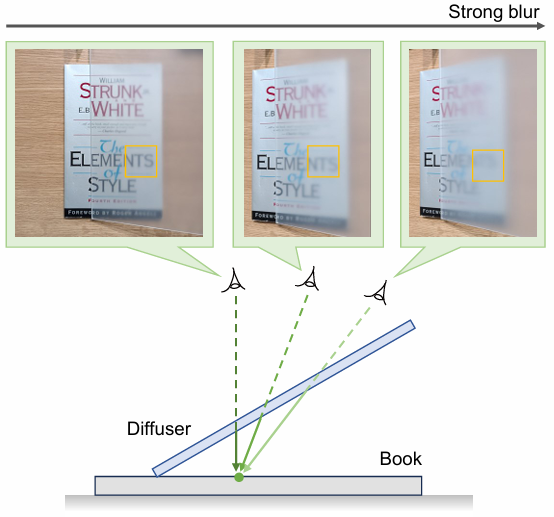
In a pinhole imaging model, the blur size is determined by geometric information, specifically the distances and viewing angles between the imaging sensor and the pinhole, and between the target object and the pinhole, as well as the magnitude of the blur parameter. We incorporate this imaging model into the 3D Gaussian Splatting (3DGS) framework and set the blur parameter as a differentiable parameter of each Gaussian primitive. By providing multiple observation images and known camera poses and performing scene reconstruction with 3DGS, it becomes possible to estimate unique blur parameters. We present quantitative experimental results in both simulation and real-world environments, confirming the effectiveness of the proposed method. 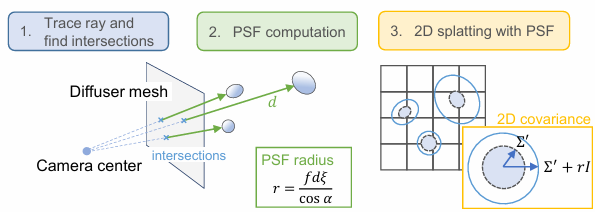
Experimental results in real-world environments. The captured images are blurred and unclear due to the diffuser, but the proposed method successfully restores high-frequency components. Notable differences can be observed particularly in the enlarged views of the text, the bottom of the apple, and the eyes of the mandrill. 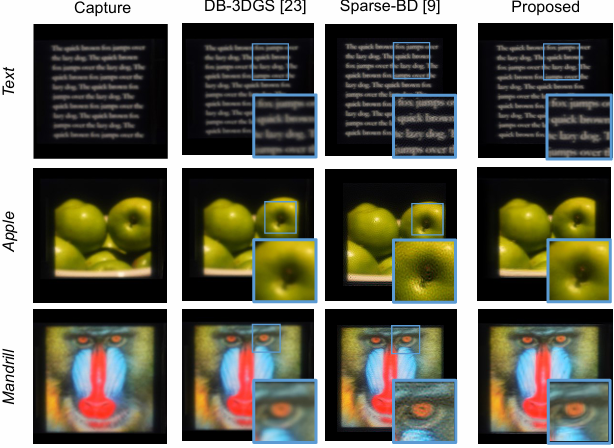
Publications
|
| Computer Vision and Graphics Laboratory |