Neural 4D Scene Reconstruction with Multiple One-Shot Scanning Systems
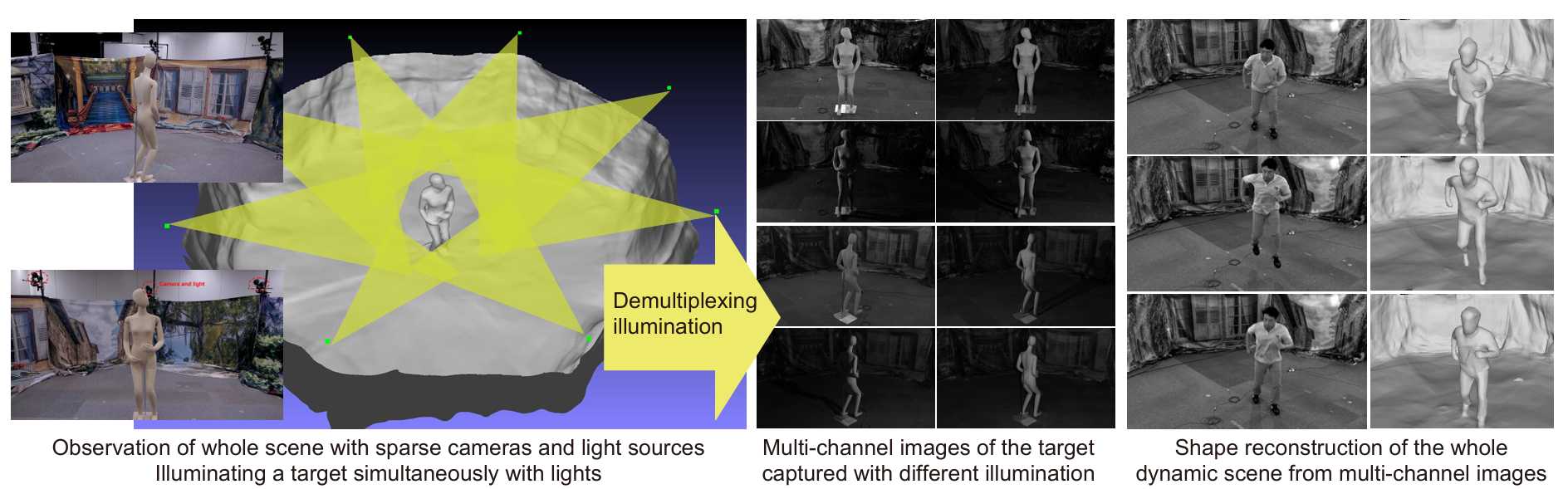
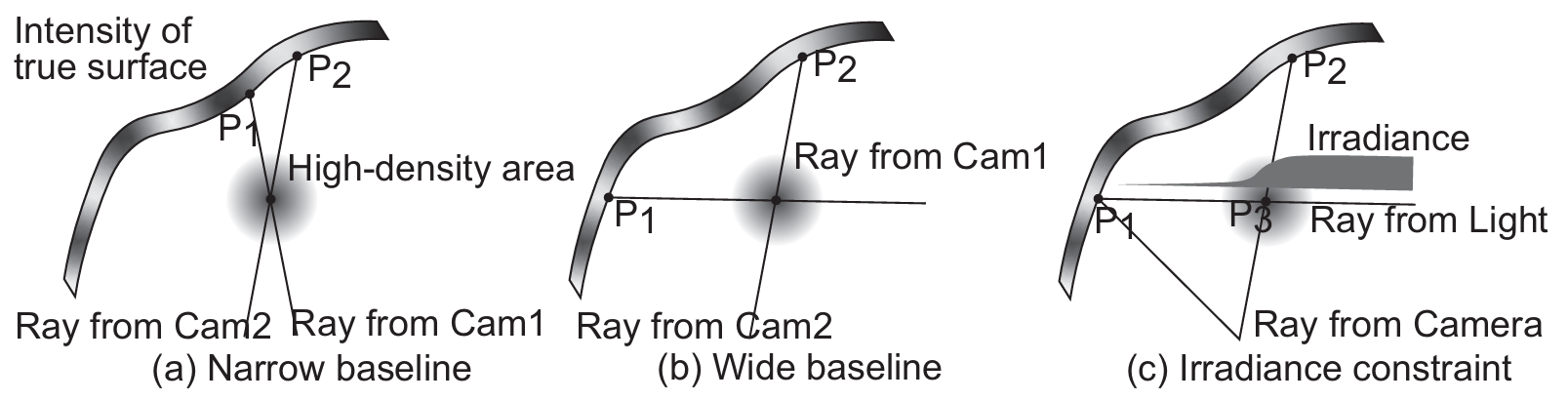
Reconstructing dynamic 3D shape from only a few fixed cameras is difficult because sparse views provide weak correspondence cues and wide baselines make neural multiview stereo unstable. Active lighting can add useful information, but sequentially changing illumination does not work well for moving targets. To address this issue, we propose a neural 4D reconstruction method that combines sparse-view capture with multiple one-shot scanning systems.
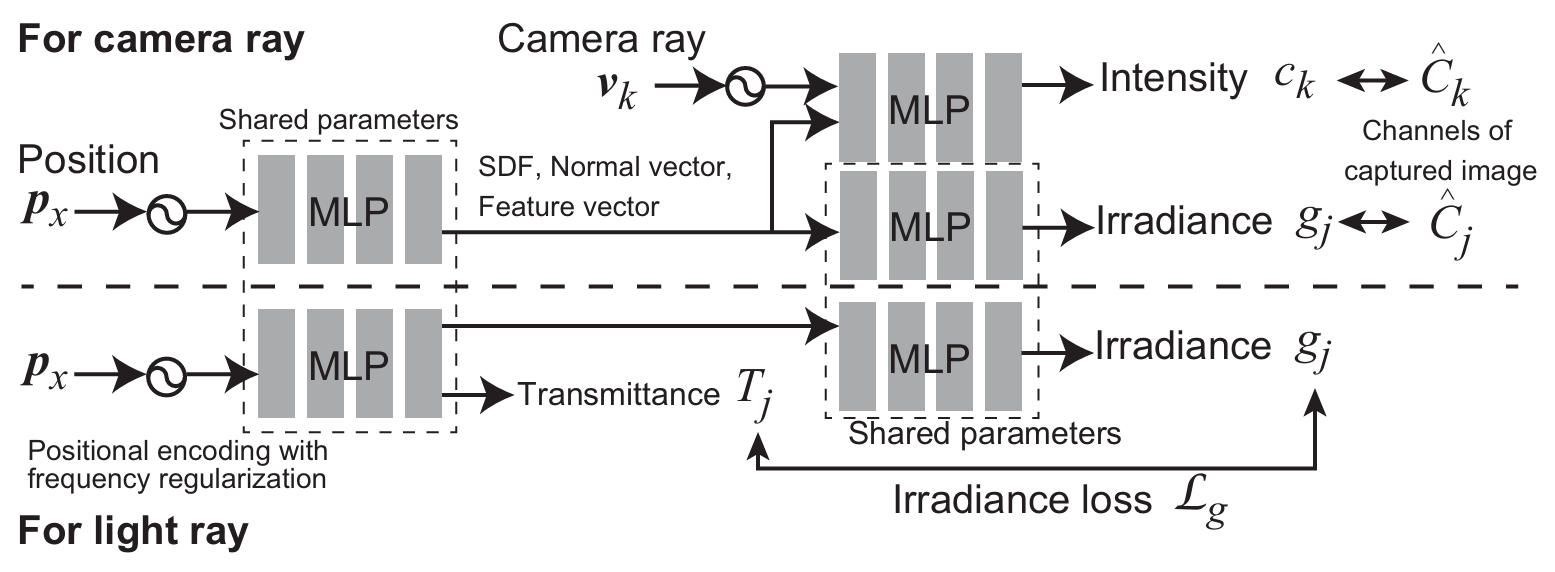
The method forms multi-channel observations under different illuminations and introduces irradiance constraints along light rays as well as camera rays during neural implicit optimization. It further uses multiplexed illumination and demultiplexing so that per-light observations can be recovered from measurements with overlapping illumination from multiple light sources, making the framework applicable to moving scenes. In this way, the system can use a small number of stationary cameras and light sources while still obtaining information that is helpful for surface reconstruction.
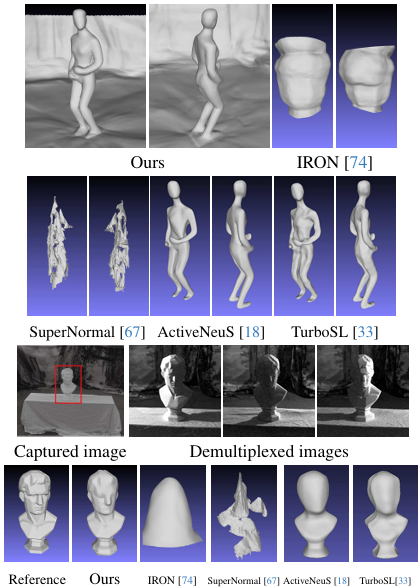
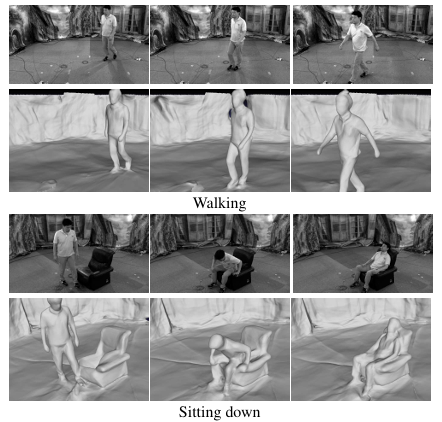
Experiments on both simulated and real data show that the proposed method achieved the best reconstruction results under sparse-view conditions. It successfully reconstructed dynamic scenes as well as static ones, demonstrating that active lighting and neural reconstruction can be combined effectively for practical 4D capture.