 |
Specular object reconstruction behind frosted glass by differentiable rendering |
We address shape reconstruction using caustics -- light concentration patterns generated by specular reflection on object surfaces. While caustic patterns reflect surface geometry, multiple normal configurations can produce the same pattern, making unique shape estimation impossible from a single observation. This research proposes a method to estimate a unique normal field by observing caustic patterns while varying the light source position, finding the solution consistent with all observations. The measurement setup is shown below. Illuminating a diffuser placed in front of the object with a point laser creates a point light source at an arbitrary position; the diffuser also serves as the observation surface for caustic patterns.
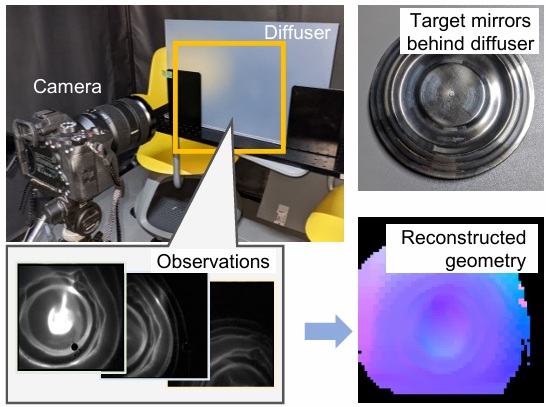
To estimate surface normals from caustics, we employ inverse rendering. We represent object geometry as a mesh and propose a fast differentiable rendering method based on rasterization that accounts for the irradiance received by surface microfacets and the area magnification ratio of corresponding caustic patterns. By taking multiple observed images and known light source positions as input, unique normal estimation becomes possible. 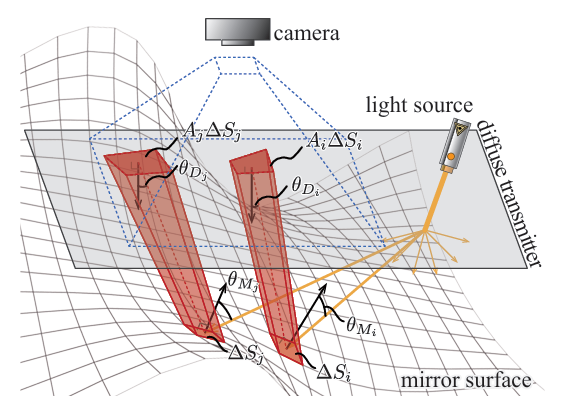
Results of simulation experiments show that complex surface geometries with fine-scale relief are successfully recovered. It was also confirmed that 3D shapes of multiple objects placed at different depths can be reconstructed. 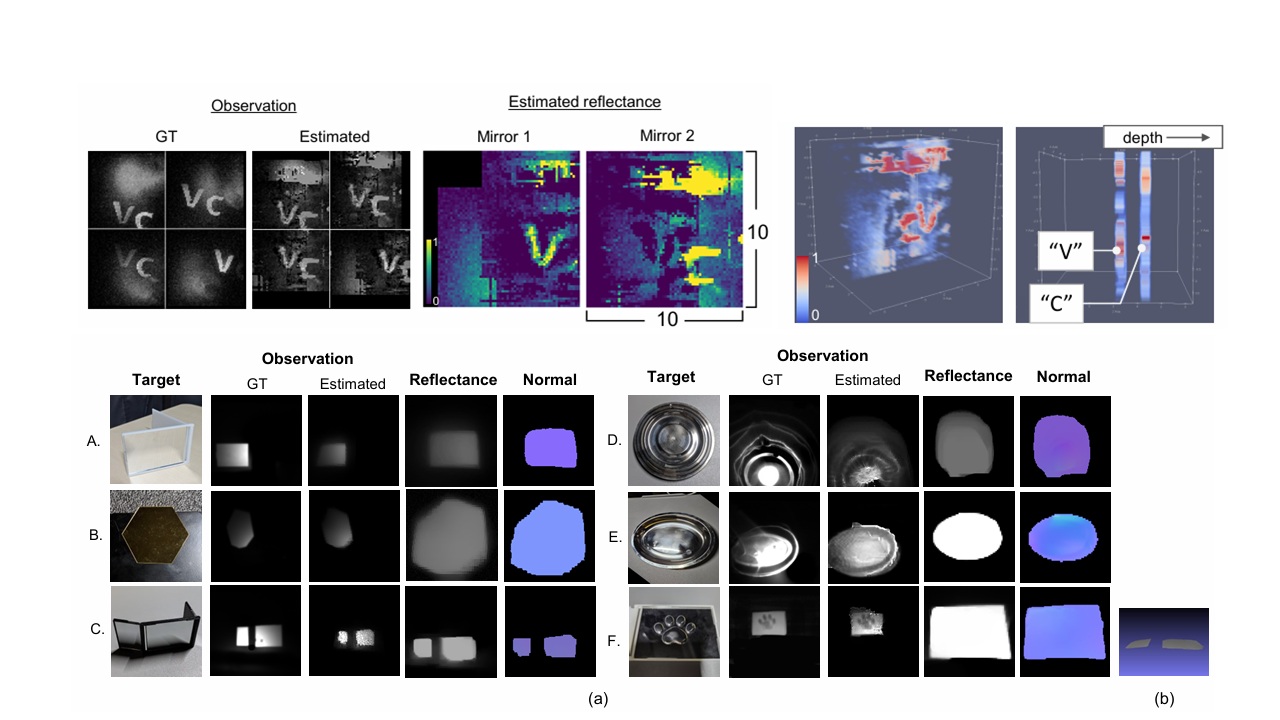
Publications
|
| Computer Vision and Graphics Laboratory |